About Chandra Archive Proposer Instruments & Calibration Newsletters Data Analysis HelpDesk Calibration Database NASA Archives & Centers Chandra Science Links

Chapter 1 | Chapter 2 | Chapter 3 | Chapter 4 | Chapter 5

Chapter 6 | Chapter 7 | Chapter 8 | Chapter 9

PREVIOUS INDEX NEXT

Chapter 4
High Resolution Mirror Assembly (HRMA)

4.1  Introduction

The Chandra X-ray telescope consists of 4 pairs of concentric thin-walled, grazing-incidence Wolter Type-I mirrors called the High Resolution Mirror Assembly (HRMA) [X-ray optics are reviewed by B. Aschenbach (1985)]. The front mirror of each pair is a paraboloid (Pn) and the back a hyperboloid (Hn). The eight mirrors were fabricated from Zerodur glass, polished, and coated with iridium on a binding layer of chromium.

4.1.1  Description and Physical Configuration

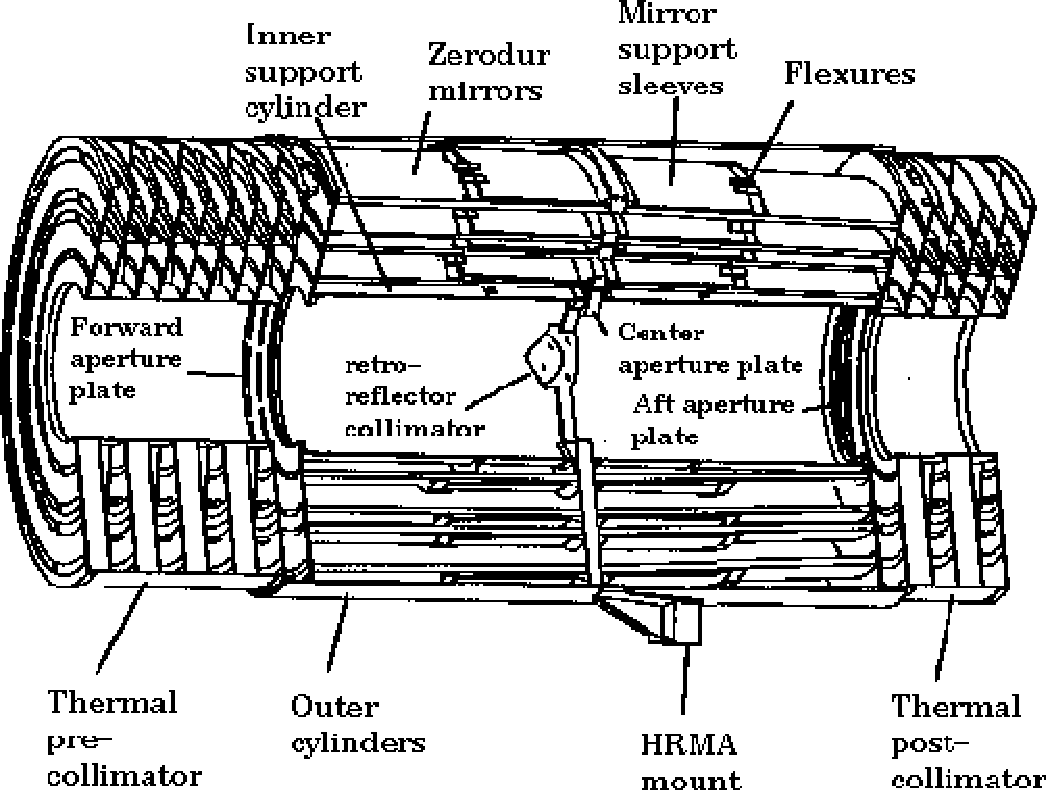
The HRMA, shown schematically in Figure 4.1, contains the nested mirrors, center, forward and aft aperture plates, baffles, inner and outer cylinders, mounts, pre- and post-collimators, fiducial light transfer components, mirror support sleeves, forward and aft contamination covers, flux contamination monitors, and thermal control hardware. The outer mirror pair is number 1, and, progressing inwards, 3, 4, and 6. The original design had six mirror pairs; numbers 2 and 5 were eliminated. The pair diameters range from about 0.65 to 1.23 meters. The distance from the center of the Central Aperture Plate (CAP) separating the paraboloid and hyperboloid mirrors to the HRMA focus is 10.0548 meters, with each mirror pair varying slightly about this value. Note that this distance is close to, but not exactly, the focal length . An annular on-axis beam enters each mirror pair, is reflected from paraboloids and hyperboloids and exits to converge to a focus. The angle θ between the direction of the reflected ray and the optical axis lies between two cone angles θc and θd. These and other important HRMA characteristics are listed in Table 4.1.
./images/hrma-config.png
Figure 4.1: The four nested HRMA mirror pairs and associated structures.
Link to pdf for Figure 4.1
Table 4.1: Chandra HRMA Characteristics

    Optics Wolter Type-I
    Mirror coating Iridium (330 Å, nominal)
    Mirror outer diameters (1, 3, 4, 6)1.23, 0.99, 0.87, 0.65 m
    Mirror lengths (Pn or Hn) 84 cm
    Total length (pre- to post-collimator) 276 cm
    Unobscured clear aperture 1145 cm2
    HRMA mass 1484 kg
    Focal length 10.070 ±0.003 m
    Plate scale 48.82 ±0.02 μm arcsec1
    Exit cone angles from each hyperboloid:
      θc (1, 3, 4, 6)3.42°, 2.75°, 2.42°, 1.80°
      θd (1, 3, 4, 6)3.50°, 2.82°, 2.49°, 1.90°
    f-ratios (1, 3, 4, 6)8.4, 10.4, 11.8, 15.7
    PSF FWHM (with detector) 0.5′′
   
Effective area:
@ 0.25 keV 800 cm2
@ 5.0 keV 400 cm2
@ 8.0 keV 100 cm2
    Ghost-free field of view 30′ diameter

4.1.2  Sub-assembly Calibration

Extensive measurements of the mirror shapes and of the surface characteristics were made at Hughes-Danbury Optical Systems (HDOS) during fabrication of the mirror segments and during assembly at Eastman-Kodak Co. HRMA throughput depends critically on the coating of the individual mirror elements carried out at Optical Coating Laboratory, Santa Rosa, California. Mirror flats were present in the coating chamber and coated with iridium at the same time as the HRMA mirror elements. Reflectivity of X-rays from these witness flats was measured with the X-ray beam from the synchrotron at the Brookhaven National Laboratory [Graessle, D. E., et al., 1998, 2004].

4.1.3  Operating Environment

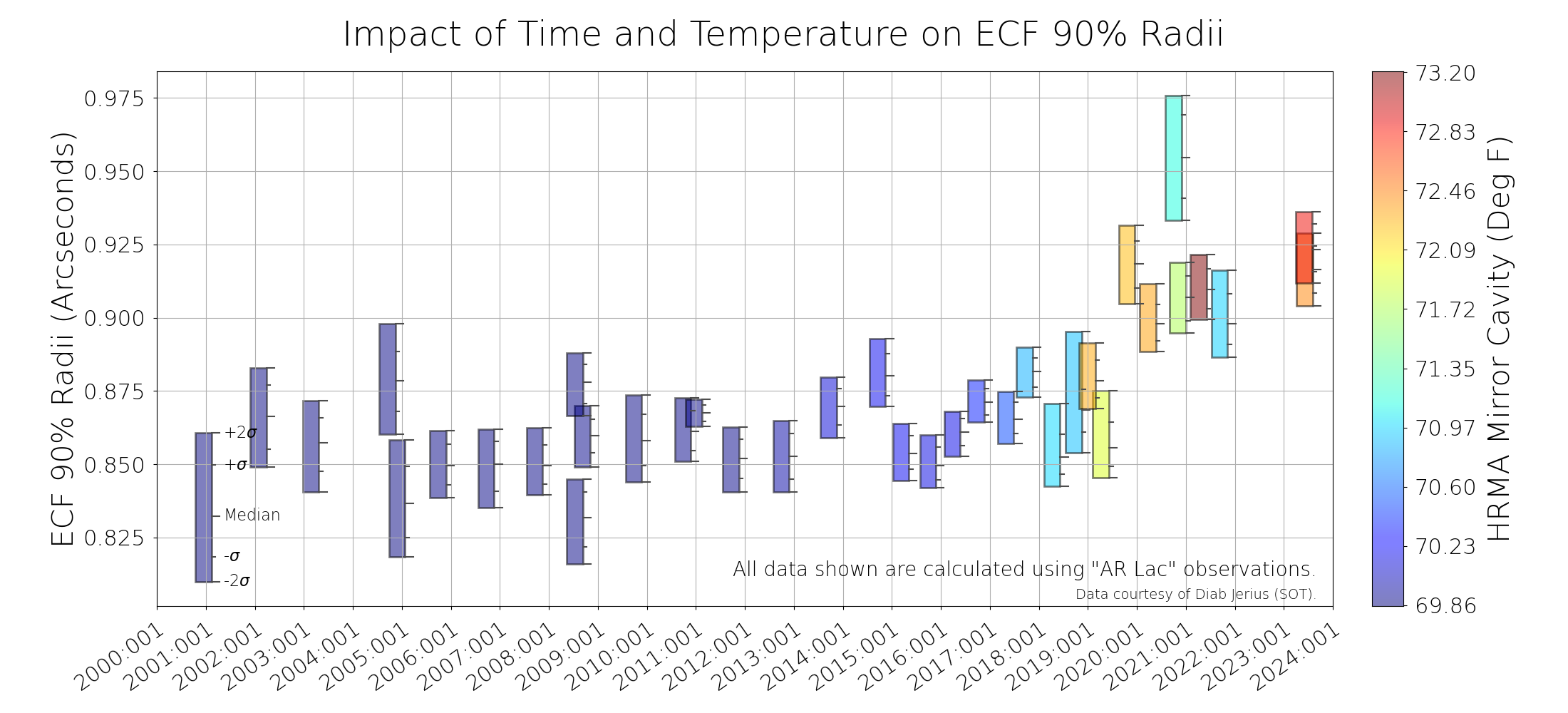
Insulation and heaters maintain the HRMA temperature at 70°F (21°C) on-orbit to minimize changes from the assembly, alignment environments, and to minimize molecular contamination.

4.1.4  Heritage

The Chandra mirrors represent a logical progression from those of the Einstein (HEAO-2) [Giacconi et al. 1979] and Rosat [Trümper 1983; Aschenbach 1991] missions. Each of these previous X-ray observatories utilized nested Wolter Type-I optics with about 4 arcsec angular resolution. The Einstein mirror assembly had considerably less geometric area than Chandra, while Rosat had comparable area (1100 cm2) at low energies ( < 1 keV).
To verify the technology required for the spatial resolution of Chandra, a Validation Engineering Test Article-I (VETA-I ) was constructed and tested in 1991. VETA-I contained the P1H1 proto-flight mirror shells constructed to final tolerances, but uncoated and with ends uncut. The VETA-I tests included the image full-width-half-maximum, encircled energy, effective area, and ring focus properties (for azimuthal and low spatial-frequency figure). Many of the results of these tests appear in SPIE Proceedings 1742. A good overview of the VETA tests is given by Zhao et al. 1994, in SPIE Proceedings 2011.

4.2  Calibration and Performance

4.2.1  Calibration and Model

Before launch, the HRMA underwent extensive ground calibration tests at the X-Ray Calibration Facility (XRCF) at Marshall Space Flight Center (MSFC), Huntsville, AL, from September 1996 through May 1997. The full HRMA XRCF Calibration Report is accessible at http://cxc.harvard.edu/cal/Hrma/XRCF_Report. During these tests, the mirror assembly was mounted horizontally in a vacuum chamber and irradiated with X-rays from various electron-impact sources located at a distance of 524.7 meters. The data taken at the XRCF include the effective area and image distributions as a function of incident energy and angle. The mirror performance during these tests differs from that expected in space because of gravity distortions and the finite source size and distance; consequently, the calibration data cannot be directly compared to flight observations. The approach taken was to develop a model based upon surface and assembly measurements taken before the X-ray calibration activity. The X-ray calibration data then were used to validate this model and to make minor adjustments in model parameters to achieve satisfactory agreement with the observations. Further minor modifications were made as a result of flight experience. A series of papers in SPIE Proceedings 3113 report the results of the HRMA ground calibration.
The HRMA characteristics illustrated in this chapter were generated by a ray-trace program using this model. Note that this chapter typically gives characteristics of the HRMA only; unless otherwise indicated, blurring caused by the detector and the aspect solution is not included. These effects are very important for on-axis sources, and are included in the instrument chapters (Chapters 6 and 7). See also section 4.4.

4.2.2  HRMA Effective Area

The unobscured geometric clear aperture of the HRMA is 1145 cm2. The obstruction of the HRMA clear aperture by supporting struts is less than 10%. Since reflectivity depends on energy as well as grazing angle, the HRMA throughput varies with X-ray energy.
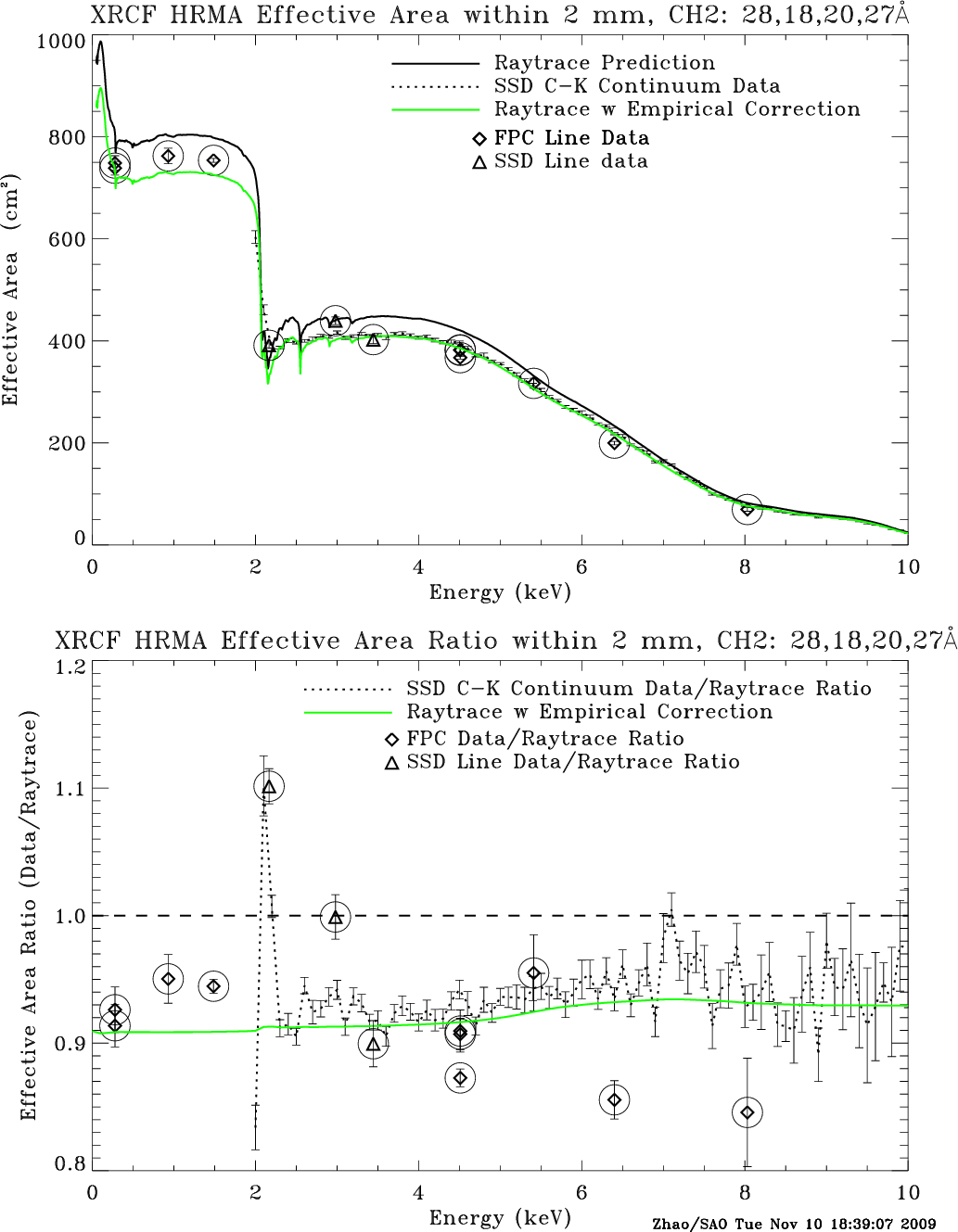
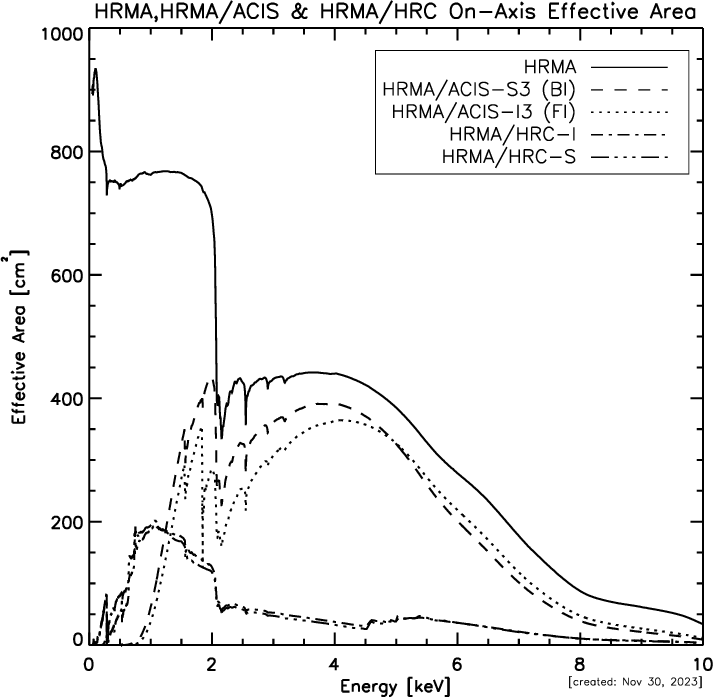
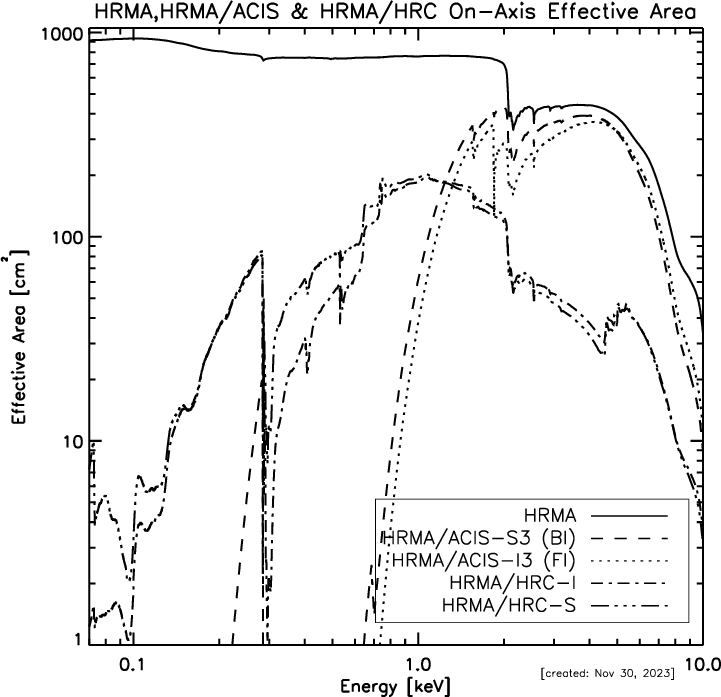
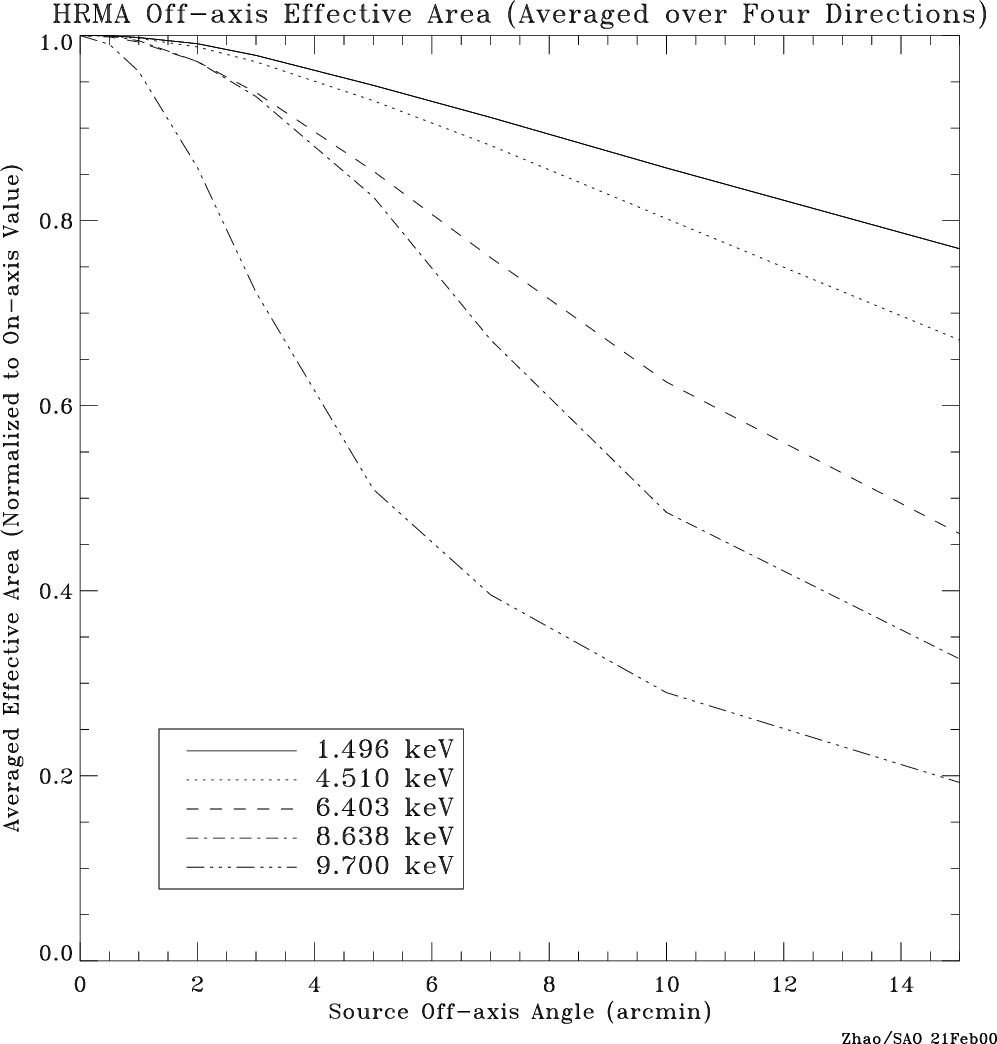
The HRMA effective area is calculated based upon the mirror model discussed above and scaled by the XRCF ground calibration data. Figure 4.2 shows the effective area predicted for the ground calibration using this model and the actual measurements, as well as the scaling function used for the on-orbit prediction. Figure 4.3 shows the predicted on-orbit HRMA effective area as a function of energy, in linear and log scale, as well as the HRMA/ACIS and HRMA/HRC effective areas. Figure 4.4 shows the effects of off-axis vignetting on the effective area for various energies; the plotted results are averages over the four azimuthal directions.
 
./images/hrma_ea_data_wfpc.png
Figure 4.2: The HRMA effective area at the XRCF. Top panel: the solid line is the raytrace simulation of the effective area within a 2 mm diameter aperture at the focus; the dashed line with error bars shows the data taken with a solid state detector (SSD) with a C-K continuum source; the symbols in big circles show data taken with a flow proportional counter (FPC: diamonds) or SSD (triangles) with spectral line sources.The bottom panel shows the deviation of the data from the raytrace: the dotted line is the ratio of the SSD C-K continuum data to the raytrace; the diamonds and triangles show the ratio of the FPC and SSD data to the raytrace, respectively. Also shown (in red) is a solid line that represents the results of fitting a polynomial to the data. This fit gave equal weight to the deviations of the continuum and line measurements. [Note the red line is viewable in the electronic version.]
Link to pdf for Figure 4.2
 
./images/hrma_ea_onaxis_qe.png
Figure 4.3: The HRMA/ACIS and HRMA/HRC effective areas versus X-ray energy in linear-linear (top) and log-log (bottom) scales. The structure near 2 keV is due to the iridium M-edge. The HRMA effective area is calculated by the raytrace simulation based on the HRMA model and scaled by the XRCF calibration data. The HRMA/ACIS effective area is the product of the HRMA effective area and the Quantum Efficiency (QE) of ACIS-I3 (front illuminated) or ACIS-S3 (back illuminated). The HRMA/HRC effective area is the product of HRMA effective area and the QE of HRC-I or HRC-S at their aimpoints, including the effect of UV/Ion Shields (UVIS). [Note: the colored lines are viewable in the electronic version]
Link to pdf for Figure 4.3
./images/hrma_ea_offaxis.png
Figure 4.4: The HRMA  effective area versus off-axis angle, averaged over four azimuthal directions, for selected energies, normalized to the on-axis area for that energy.
Link to pdf for Figure 4.4

Uncertainties in the effective area near the Ir MV edge

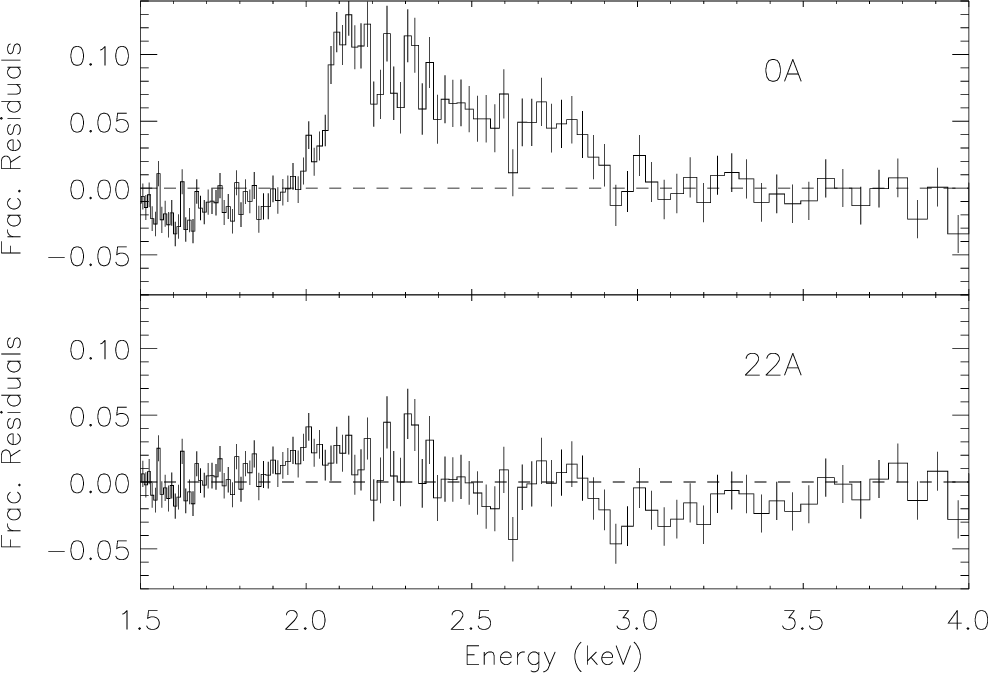
Observations of power-law sources (blazars) using HETG/ACIS-S show evidence of discrepancies in the predicted HRMA effective area near the Ir M edges (above 2.05 keV) - see Figure 4.5. The data shown are combined residuals from power-law fits to 18 blazars by Marshall (2005). Based upon simulations of the effects of contamination on the HRMA optics, we believe that a very thin layer of hydrocarbons was deposited on the mirror surface (not to be confused with the contaminant on the ACIS optical blocking filter, see Section 6.3). The models used in the upper panel of Figure 4.5 are based upon contaminant free optics, those used in lower panel include a 22Å hydrocarbon contamination. It has still not been determined when this contamination was deposited, but it was most likely prior to launch based on the relative exposure to different environments.
./images/hrma_ea_irm.png
Figure 4.5: Combined residuals from power law fits to 18 blazar observations (Marshall, H.L., 2005). The residuals in the upper panel are based upon models of contaminant free optics, while those in the lower are based upon a model of the mirror surfaces which includes a thin (22Å) hydrocarbon layer. Features in observations near the Ir M edges should be regarded with skepticism.
Link to pdf for Figure 4.5
Because there was a concern that the effective area might change between ground calibration and flight due to accumulation of contaminants or degradation of the reflecting surfaces, a Flux Contamination Monitor (FCM) was incorporated into the telescope to evaluate these effects [Elsner et al., 1998]. The FCM consists of radioactive sources embedded in the forward contamination cover of the HRMA. The ACIS response to these sources was measured in the XRCF at the end of ground calibration, and again in orbit before the forward contamination cover was removed. No change in performance was detected. However, these measurements would not have detected a change as small as 22Å. Marshall (2005a) has examined spectra taken throughout the mission, and does not see evidence of a change over time in the telescope response near the Ir M edges. (The Chandra detectors are not exposed to the FCM now that the forward contamination cover has been opened, and so can provide no further information.)
Whatever its origin, the evidence so far is that the contamination layer has been present since the beginning of the mission, is stable, and is unrelated to the molecular contamination of the ACIS filters. A version of the HRMA effective area including the contamination is included in the CALDB release since v3.2.1 (December 2005). The net effect is to increase the effective area of the HRMA plus instrument combination. While the new effective area markedly reduces the discrepancies, it would be wise to regard the details of the observed features near the Ir edges with skepticism.

4.2.3  Point-Spread-Function and Encircled Energy Fraction

The Chandra HRMA point-spread function (PSF ) has been simulated with numerical ray-trace calculations based upon the mirror model previously discussed. A most useful parameter is the encircled energy fraction (the two-dimensional integral of the PSF ) as a function of radius from the image center. The PSF and the encircled energy fraction for a given radius depend upon off-axis angle and energy. The HRMA optical axis is defined for practical purposes, and calibrated in flight, as the direction of the sharpest PSF. The PSF broadens, and the encircled energy fraction decreases, as (1) the off-axis angle increases because of mirror aberrations; and (2) the X-ray energy increases because of increased X-ray scattering.

On-axis PSF

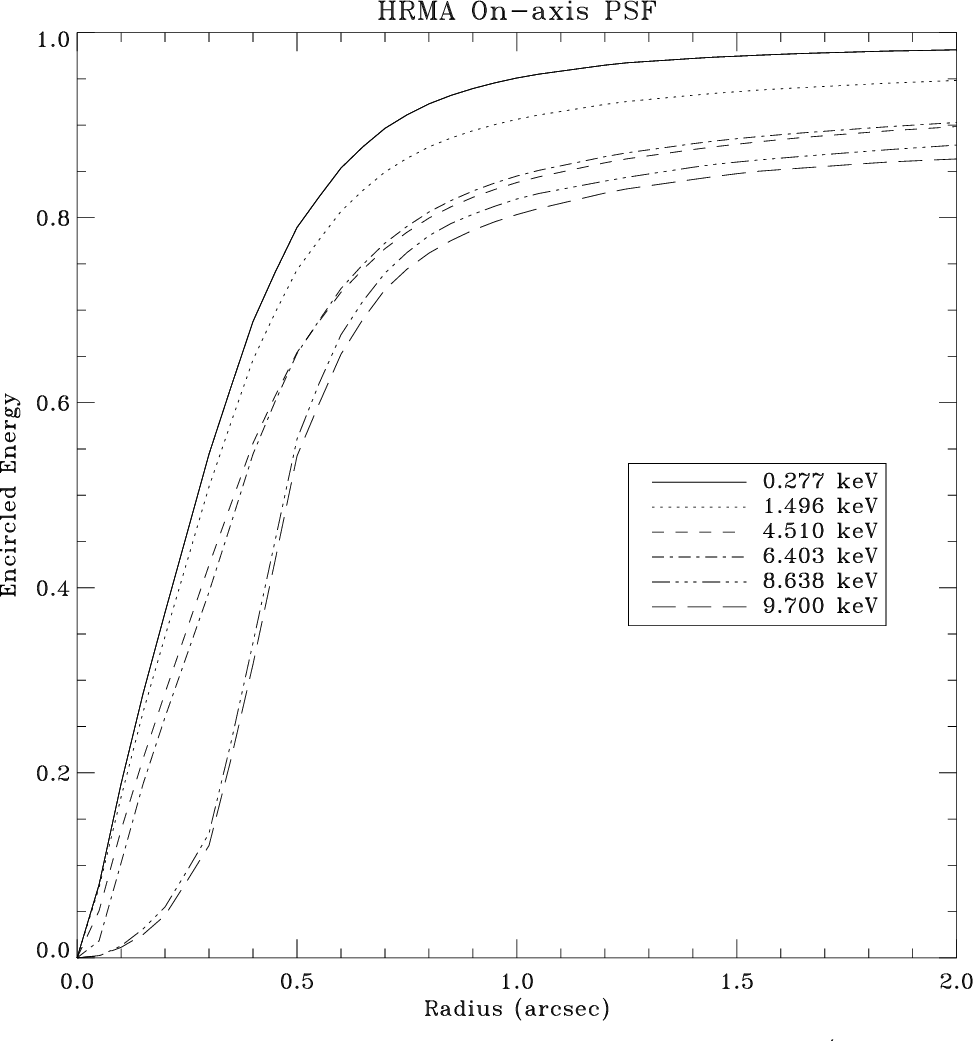
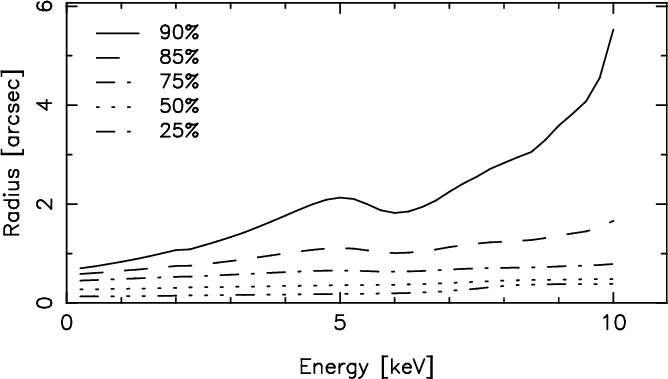
Figure 4.6 shows the encircled energy fraction as a function of image radius for an on-axis point source and for different energies. The resulting increase in image size with energy is apparent. Figure 4.7 shows the radii of selected encircled energy fractions as functions of energy for an on-axis point source. Table 4.2 lists the encircled energy fraction contained within one and ten arc seconds diameters for an on-axis point source at different energies.
./images/hrma_psf_guide_fp.png
Figure 4.6: The Fractional encircled energy as a function of angular radius, calculated for an on-axis point source, at selected X-ray energies. The curves are the combined response and centered at the common focus of the full HRMA, i.e. four nested mirror pairs. For higher energies (8.638 keV and 9.700 keV), the curves are broadened at the bottom. This is because the focus of higher energies does not coincide with the the HRMA common focus, but is offset by about 0.2′′, due to a slight tilt of the HRMA mirror pair 6.
Link to pdf for Figure 4.6
./images/hrma_ee.png
Figure 4.7: The radii of selected encircled energy fractions as functions of X-ray energy for an on-axis point source, calculated from the mirror model derived from ground-based calibration data.
Link to pdf for Figure 4.7
Table 4.2: HRMA Encircled Energy Performance

X-ray:Encircled Energy Fraction
EλDiameter
keVÅ1′′ 10′′
0.1085 114.2712 0.7954 0.9979
0.1833 67.6401 0.7937 0.9955
0.2770 44.7597 0.7906 0.9929
0.5230 23.7064 0.7817 0.9871
0.9297 13.3359 0.7650 0.9780
1.4967 8.2838 0.7436 0.9739
2.0424 6.0706 0.7261 0.9674
2.9843 4.1545 0.6960 0.9560
3.4440 3.6000 0.6808 0.9479
4.5108 2.7486 0.6510 0.9319
5.4147 2.2898 0.6426 0.9300
6.4038 1.9361 0.6365 0.9344
8.0478 1.5406 0.5457 0.9185
8.6389 1.4352 0.5256 0.9151
10.0000 1.2398 0.4971 0.8954
Pre-flight measurements and images taken at the XRCF show that there is a slight ( ≈ 500 μm) offset between the optical axes of the paraboloids and hyperboloids, and that pair 6 is slightly tilted with respect to the other three. Consequently, the image from mirror pair 6 is not as symmetrical as the images produced by the other shells. The effect of this asymmetry on images depends on energy because of the different relative contribution of mirror pair 6.
./images/hrma_hrc_onaxis_image_bw.png
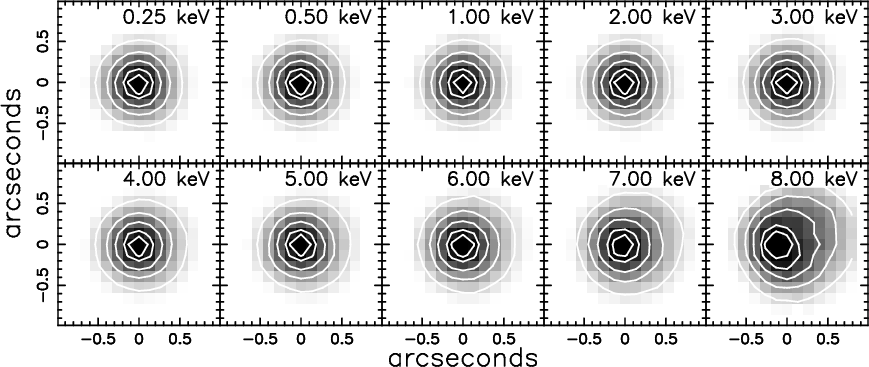
Figure 4.8: Simulated on-axis HRMA/HRC-I images of on-axis mono-energetic point sources with aspect blurring. The grayscale is a linear stretch; surface brightness contours are at 90%, 80%, 60%, 40%, and 20% of the peak brightness. The 8 keV image core is off-center due to the shell 6 misalignment.
Link to pdf for Figure 4.8
Figure 4.8 shows simulated HRMA/HRC-I images at several energies. The effect of the mirror pair 6 alignment errors can be seen in the higher energy images as then mirror pair 6 becomes the dominant contributor to the total effective area. Note the movement of position of the core as well as the asymmetric flaring. The  ∼ 0.2′′ core motion is comparable to other factors of image degradation encountered in flight, such as uncertainties in the aspect solution.
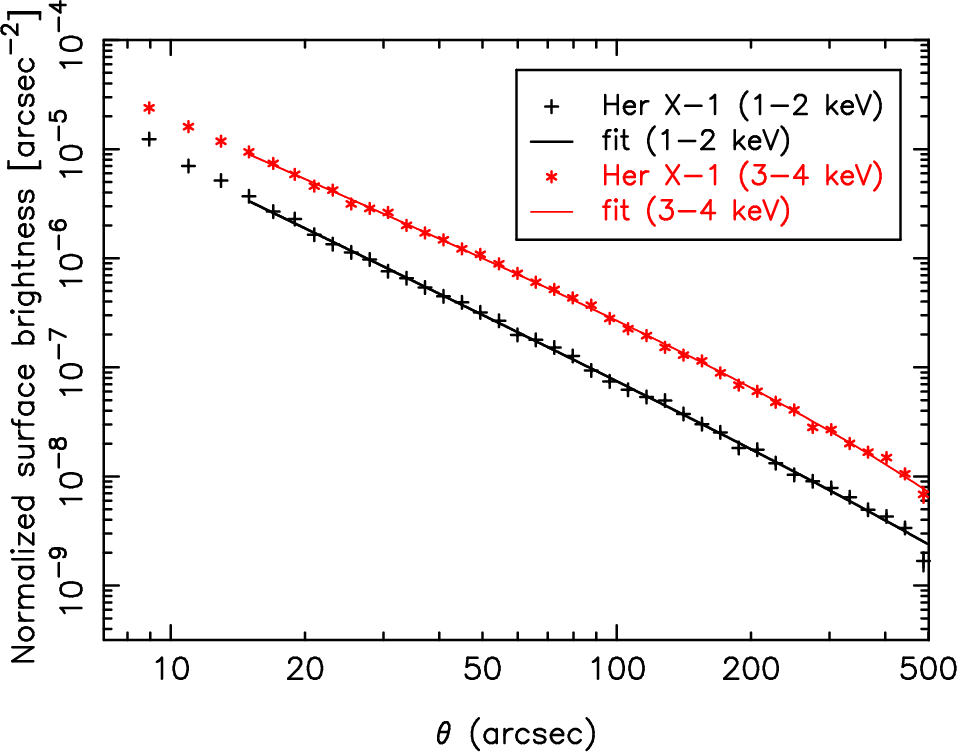
The HRMA PSF has a faint halo extending to large angles, resulting from X-rays scattering from micro-roughness on the mirror surfaces. This scattering is energy dependent; the spectrum of the scattered X-rays hardens significantly with increasing angle from the source. An empirical model was generated based on the ground calibration measurements; a number of systematic effects remain to be accounted for, and the uncertainties in the flux in the wings are probably at least 30-50%. This model is described more fully in http://cxc.harvard.edu/cal/Hrma/psf/XRCF_PSF_wing_profile/ A deep calibration observation of Her X-1 (obsid 3662) was obtained in order to improve the understanding of the PSF wings. The SIM was shifted to move the optical axis to  ∼ 1′ from the edge of the S3 detector furthest from the frame store; a Y-offset moved the image  ∼ 1′ into node 0 of the detector. The resulting pointing is  ∼ 45′′ off-axis, effectively on-axis with regard to the mirror scattering properties. The analysis is discussed in more detail in http://cxc.harvard.edu/cal/Hrma/psf/wing_analysis.ps; see also http://cxc.harvard.edu/cal/Hrma/users_guide
Radial profiles of the Her X-1 scattering wings for 1.0-2.0 keV and 3.0-4.0 keV are plotted in Fig. 4.9. A powerlaw plus exponential cutoff is overplotted; the fit applies for θ > 15′′. The results for the empirical ground-based model are also plotted. The agreement is reasonably good above  ∼ 2 keV (e.g., Fig. 4.9, lower panel), but below 2 keV, the agreement is less satisfactory. In all cases, the ground-based empirical model underpredicts the surface brightness below  ∼ 20′′; the reason for this is not presently understood.
./images/hrma_wings_1-2.png
./images/hrma_wings_3-4.png
Figure 4.9: Radial profile of the Her X-1 scattering wings. Upper panel: 1.0-2.0 keV. The heavy solid line is a powerlaw plus exponential cutoff fit to the data; the heavy dash-dot lines are results from an empirical model based on ground testing for 1.0, 1.5, and 2.0 keV (lower curve to upper curve). Lower panel: Radial profiles of the Her X-1 scattering wings for 3.0-4.0 keV. The results for the empirical ground-based model are also plotted.
Link to pdf for Figure  (upper panel)
Link to pdf for Figure  (lower panel)
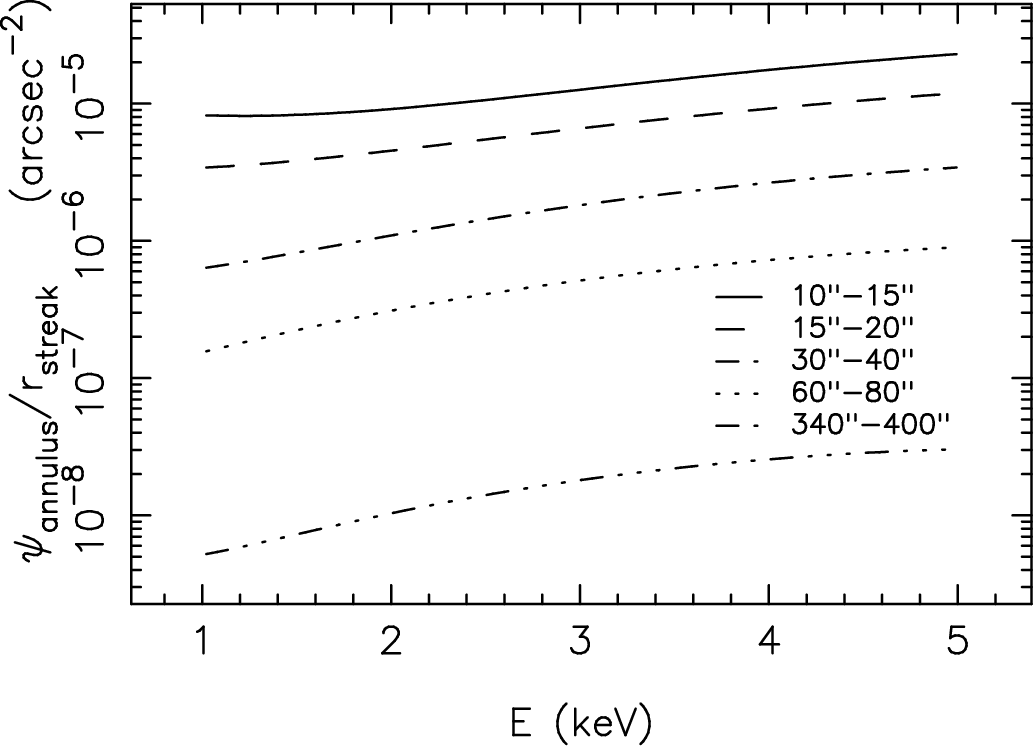
Because the mirror scattering is in part diffractive, the spectrum of diffuse mirror scattering halo is energy dependent. Spectra extracted from the diffuse mirror scattering wings of the PSF are significantly modified from the spectrum of the incident source X-rays. Generally, the scattering halo spectrum becomes harder with increasing angle from the source; it is not known at this time whether there is also an azimuthal variation. Fig. 4.10 shows the ratio of diffuse spectra extracted from annuli centered on the specular image (Her X-1) to the corresponding spectrum extracted from the ACIS transfer streak; the transfer streak spectrum is thought to be  ∼ 4% piled up in this case. To make the variations more evident, the ratios have been normalized to 1 at 2 keV.
./images/hrma_ann_over_xfrstreak.png
Figure 4.10: The ratio of the spectrum in a given annulus to the spectrum in the central core as a function of energy all normalized to 1 at 2 keV. The central core spectrum was determined from the "transfer streak" to minimize pileup which was still  ∼ 4%.
Link to pdf for Figure 4.10

Off-axis PSF

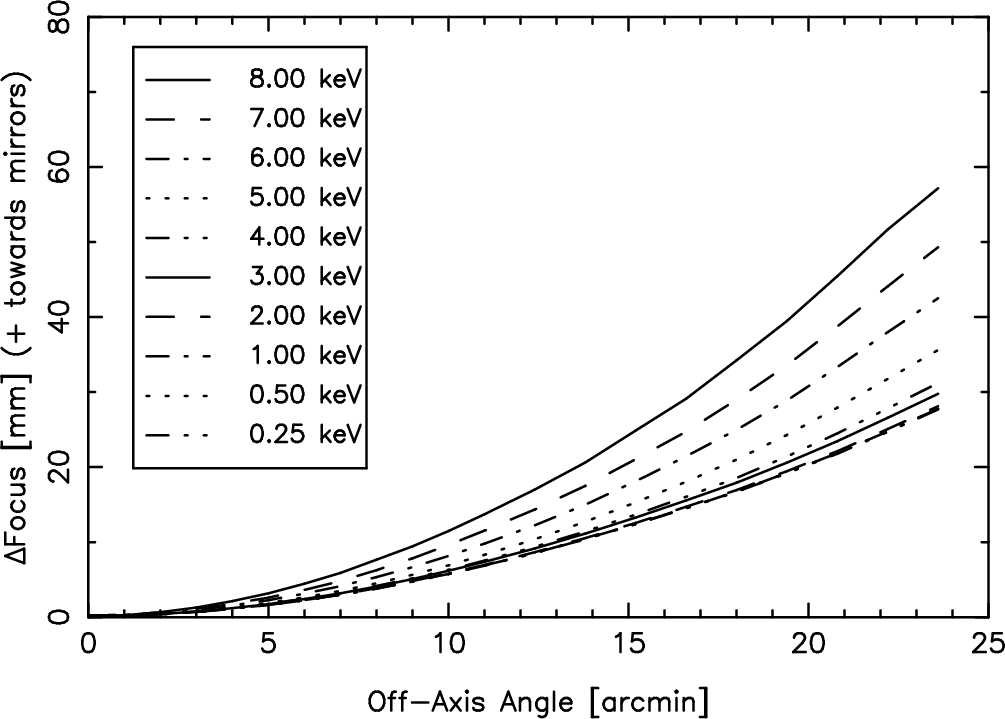
The PSF broadens for off-axis sources, and there is considerable distortion in the image even if the HRMA were perfect. This distortion is due to the aberrations of Wolter type I optics and to the different focal surfaces (Figure 4.11) for the four mirror pairs. The increase in image size with off-axis angle is greatest for the inner shell, and hence is larger for higher X-ray energies.
./images/hrma_focal_surface.png
Figure 4.11: The HRMA focal surface (from simulations), indicating its dependence on energy and off-axis source position. It deviates more from the detector planes at higher energies and larger off-axis angles, leading to significant degradation of image quality.
Link to pdf for Figure 4.11
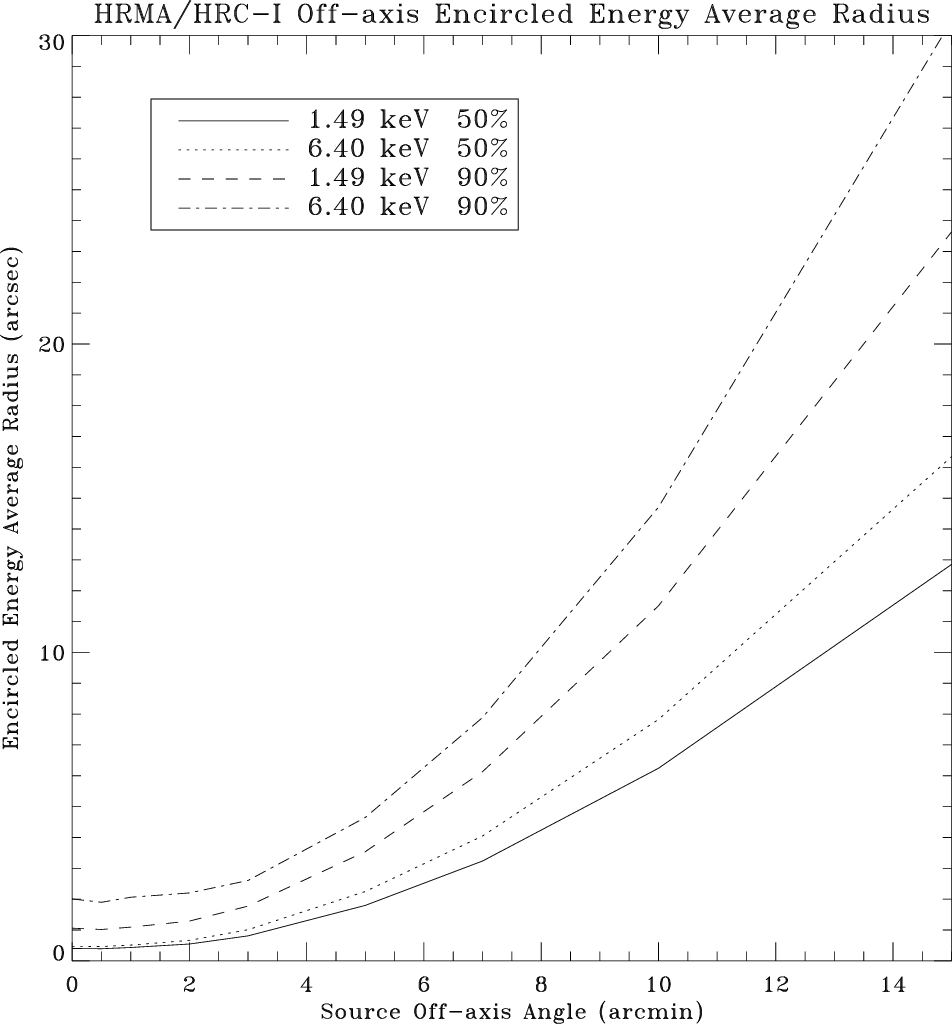
Figure 4.12 shows the dependence of encircled energy radii on off-axis angle on the HRC-I with the HRMA focus at the HRC-I aimpoint. Because the HRC-I is axially symmetric with respect to the HRMA optical axis, the off-axis encircled energy radii are almost azimuthally symmetric, except some small asymmetry due to the imperfect HRMA as mentioned above. The figure gives the averaged radii for 1.49 keV and 6.40 keV at 50% and 90% encircled energy. The blurs due to the HRC-I spatial resolution and the aspect solution, estimated to be FWHM: 0.22′′, are included.
./images/hrma_ee_offaxis_hrci.png
Figure 4.12: The HRMA/HRC-I  encircled energy average radii for circles enclosing 50% and 90% of the power at 1.49 and 6.40 keV as a function of off-axis angle. The HRC-I surface is a flat plane perpendicular to the optical axis, which does not follow the curved Chandra focal plane. These curves include the blurs due to the HRC-I spatial resolution and the Chandra aspect error.
Link to pdf for Figure 4.12
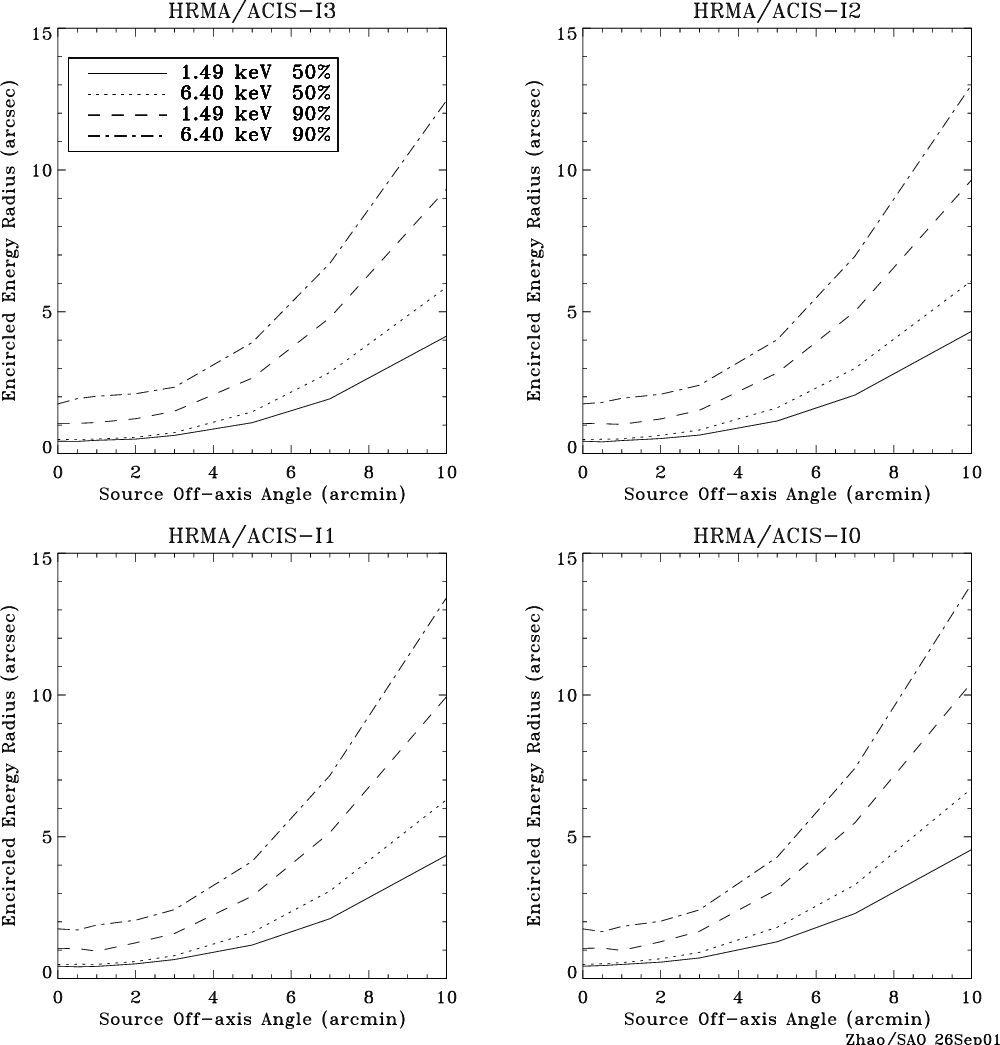
The ACIS-I surface is not axially symmetric with respect to the HRMA optical axis, because the HRMA aimpoint is located near the inner corner of one of the four ACIS-I chips - I3. Thus the off-axis encircled energy radii are not azimuthally symmetric. Figure 4.13 shows the dependence of encircled energy radii on off-axis angle on the four ACIS-I chips. The figure gives the encircled energy radii for 1.49 keV and 6.40 keV at 50% and 90% encircled energy in four azimuthal directions - from the aimpoint to the outer corners of the four ACIS-I chips. The blurs due to the ACIS-I spatial resolution and the Chandra aspect error are included.
./images/hrma_ee_offaxis_acisi.png
Figure 4.13: The HRMA/ACIS-I encircled energy radii for circles enclosing 50% and 90% of the power at 1.49 and 6.40 keV as a function of off-axis angle. The ACIS-I surface is composed by four tilted flat chips which approximate the curved Chandra focal plane. The HRMA optical axis passes near the aimpoint which is located near the inner corner of chip I3. Thus the off-axis encircled energy radii are not azimuthally symmetric. The four panels show these radii's radial dependence in four azimuthal directions - from the aimpoint to the outer corners of the four ACIS-I chips. These curves include the blurs due to the ACIS-I spatial resolution and the Chandra aspect error.
Link to pdf for Figure 4.13
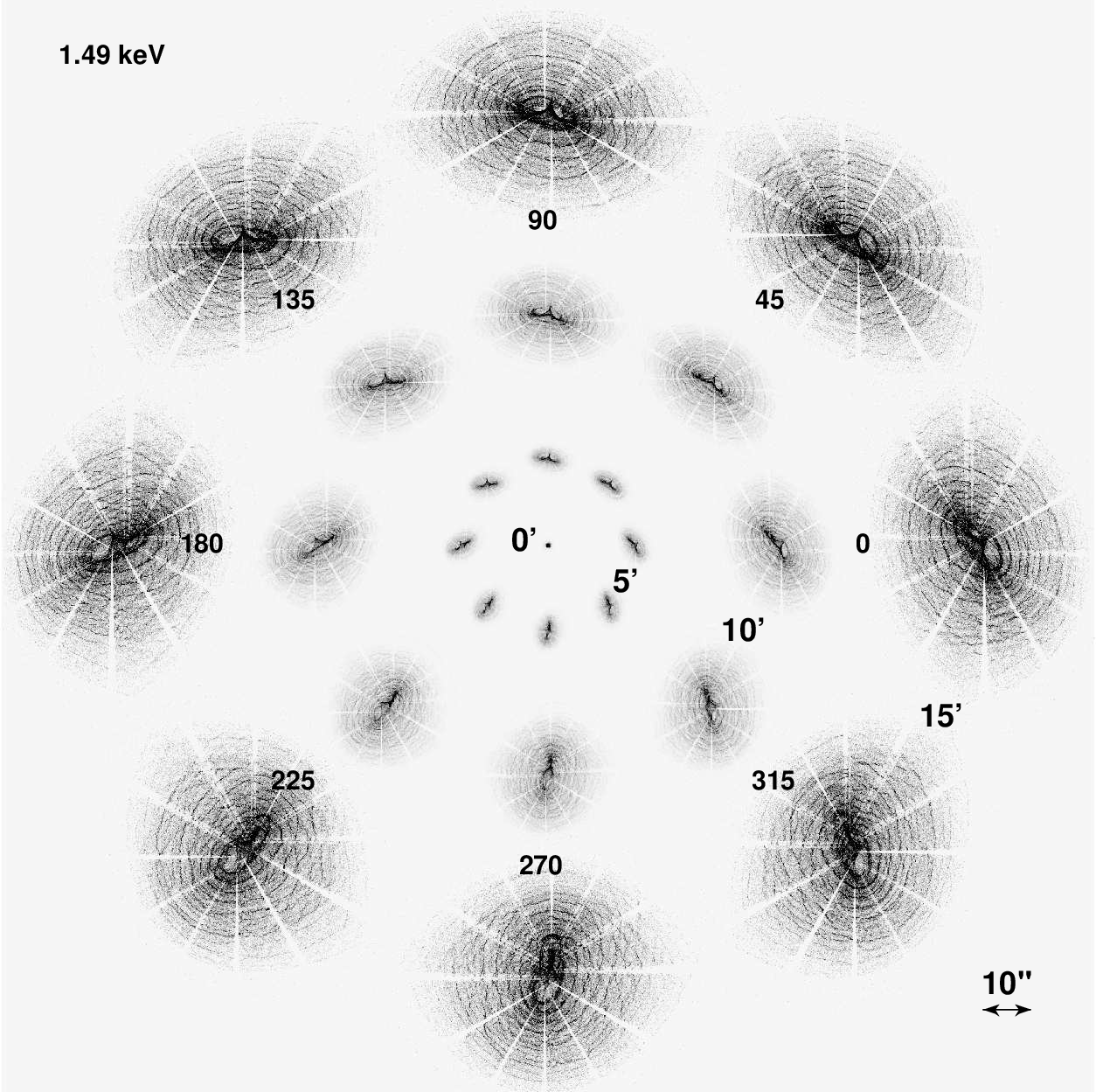
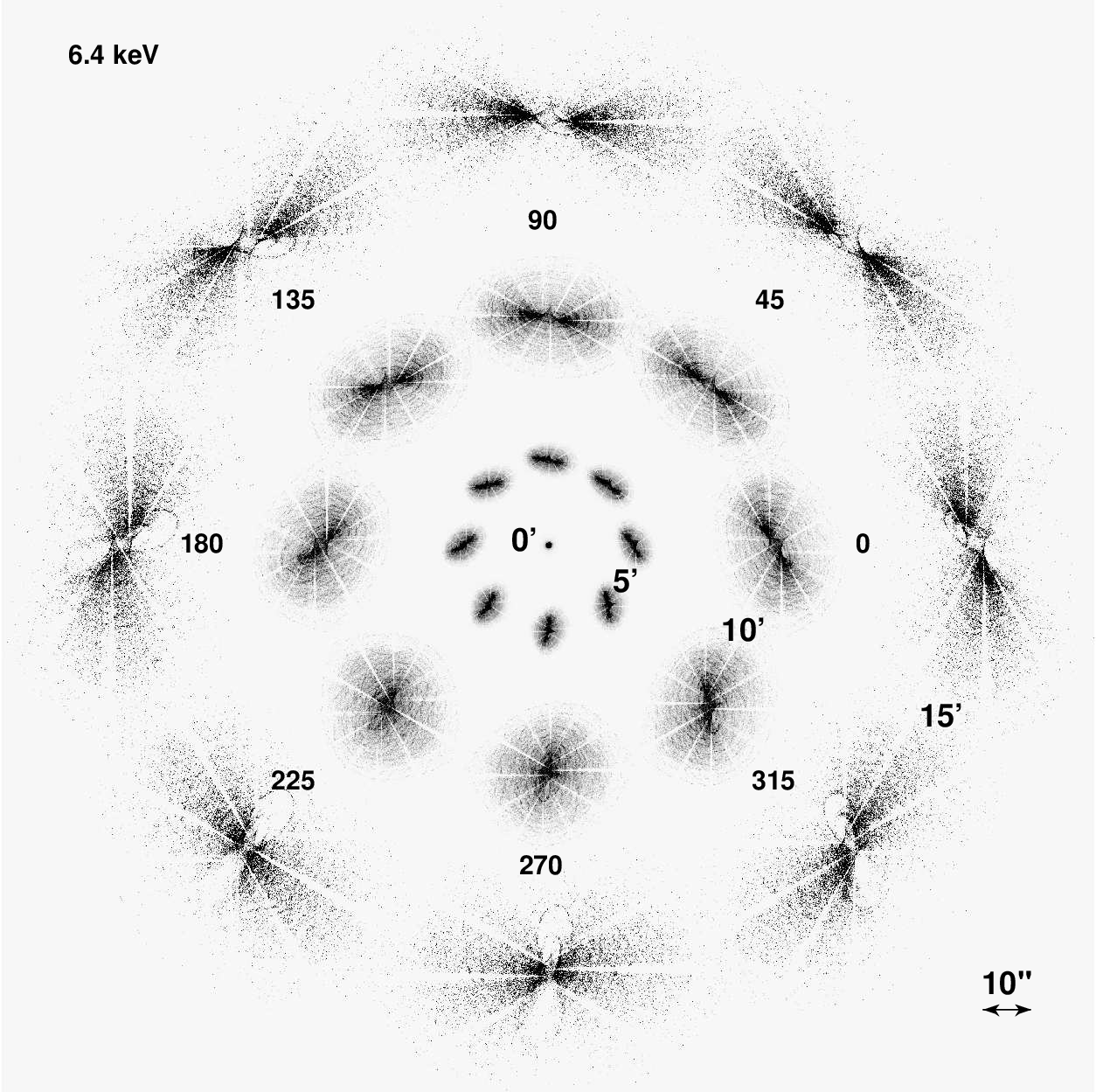
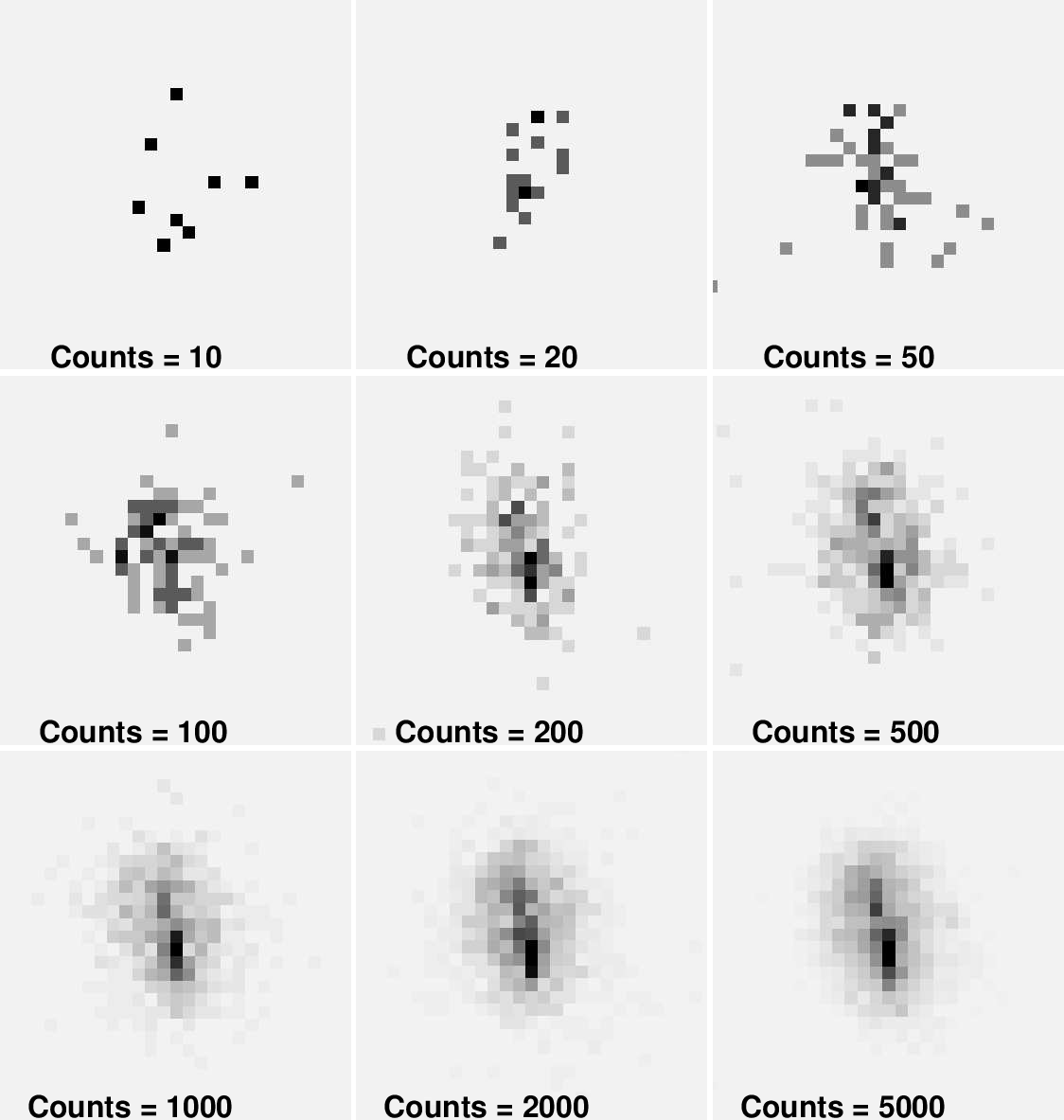
Figures 4.14 and 4.15 illustrate the effect of aberrations on images of off-axis point sources at 1.49 keV and 6.4 keV. The images are simulations of the HRMA alone, projected to the HRC-I detector plane. The dramatic degradation in image quality is primarily due to the separation between the detector plane and the effective focal plane, which is a strong function of both energy and off-axis angle (see Figure 4.11). Cusps in the HRMA images are due to a slight misalignment of the parabolic and hyperbolic mirrors. The signal in these figures is much higher than what might be expected in an actual observation. Figure 4.16 shows how the morphology of an off-axis image varies with the number of counts in the image. It is very easy to mistakenly conclude that an off-axis source is extended or has several components, even with a large number of counts.
./images/hrma_offaxis_image_1_49.png
Figure 4.14: Simulated 1.49 keV images, for the HRMA only. Images are shown with a linear stretch, as they would appear on the sky, at three off-axis angles (5′, 10′, and 15′ and various azimuths. The images are all to the same scale, illustrated by the scale bar. The spacing between images is arbitrary. The surface brightness of the images at 10′ and 15′ has been enhanced to show structure. Spokes in the images are due to shadowing by mirror support struts. Cusps are due to a slight misalignment of the parabolic and hyperbolic mirrors. These simulations are at an effective roll of zero - observations should be de-rolled before comparison to these images.
Link to pdf for Figure 4.14
./images/hrma_offaxis_image_6_4.png
Figure 4.15: Simulated 6.4 keV images, for the HRMA  only. Images are shown with a linear stretch, as they would appear on the sky, at three off-axis angles (5′, 10′, and 15′ and various azimuths. The images are all to the same scale, illustrated by the scale bar. The spacing between images is arbitrary. The surface brightness of the images at 10′ and 15′ has been enhanced to show structure. Spokes in the images are due to shadowing by mirror support struts. Cusps in are due to a slight misalignment of the parabolic and hyperbolic mirrors. These simulations are at an effective roll of zero - observations should be de-rolled before comparison to these images.
Link to pdf for Figure 4.15
./images/hrma_offaxis_image_1_49_confusion.png
Figure 4.16: A simulated 1.49 keV point source at an off-axis angle of 5′, binned to ACIS pixels. The panels show what the source would look like with a varying number of counts. Note how the morphology is a strong function of the number of counts, and how even with a large number of counts one might mistake it for an extended source or even for multiple sources.
Link to pdf for Figure 4.16

4.3  Ghost Images

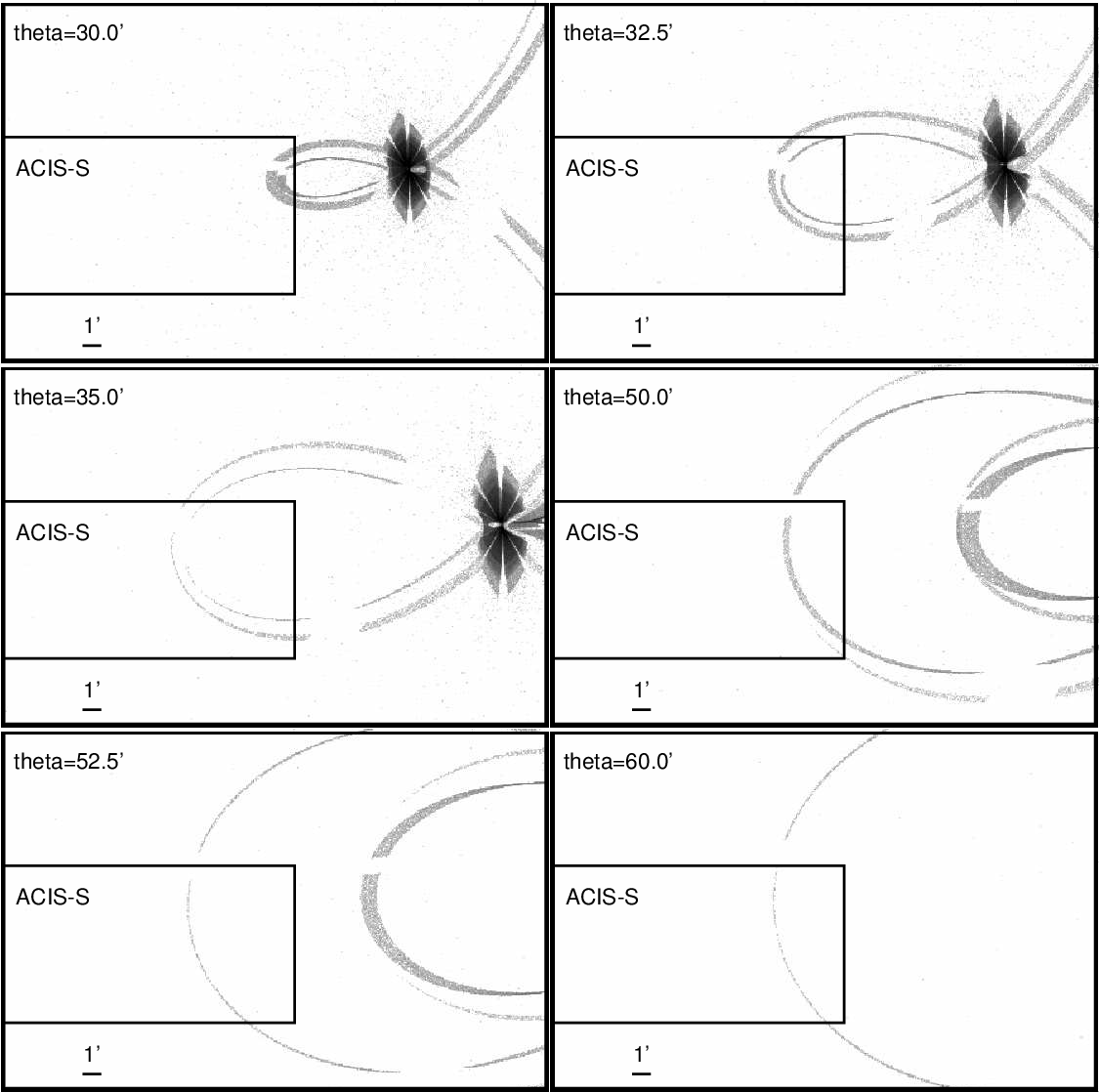
Baffles prevent non-reflected or singly reflected photons from impinging on the focal plane within the central 30′ diameter region of the field of view. Outside of this region, however, singly reflected photons from strong off-axis sources may appear. The spray of singly reflected photons is faint relative to the direct image, but can be quite complex. Each individual paraboloidal or hyperboloidal mirror can generate its own single-reflection ghosts. These form loops sweeping in toward the center of the focal plane as the source off-axis angle increases. The ghost loops from the smallest mirrors are the first to approach the central regions as source off-axis angle increases. With increasing source off-axis angle, the large mirrors come into play. As a loop approaches the central 30′ diameter region of the field of view, the inner parts of the loop fade and break up.
These single-reflection ghosts can impinge on the detector even if the source itself does not fall within the detector field of view. These ghosts mainly affect the outermost portions of those detectors which extend to large off-axis angles: HRC-I, and the spectroscopy arrays, HRC-S and ACIS-S. Figure 4.17 shows simulated ghost images on the ACIS-S array. Point sources were simulated at a range of off-axis angle θ and at a fixed off-axis azimuth (φ = 5°). The effects discussed above (fading of the loops as they approach the central field) can be seen in comparing the ghosts in the 30′-32.5′-35′ sequence, or in the 50′-52.5′ sequence.
Imaging observations with HRC-I or spectroscopy observations with HRC-S or ACIS-S which are near very bright sources can be checked using ChaRT/Marx raytraces do determine whether single-reflection ghost images are likely to be a problem.
./images/hrma_ghost_aciss_mosaic_150dpi.png
Figure 4.17: Simulated images of off-axis sources. The off-axis angle, theta (θ, in arcmin), is indicated, and all simulations were performed for the same value of φ (5°). The rectangle indicates the footprint for one end of the ACIS-S detector. These simulations illustrate how singly reflected photons can hit the detector even when the specular image is well outside the field of view. The surface brightness of these ghosts is low relative to the brightness of the X-ray sources, but could be relevant in planning observations near extremely bright X-ray sources.
Link to pdf for Figure 4.17

4.4  Effects of Aspect and Instrument Uncertainties

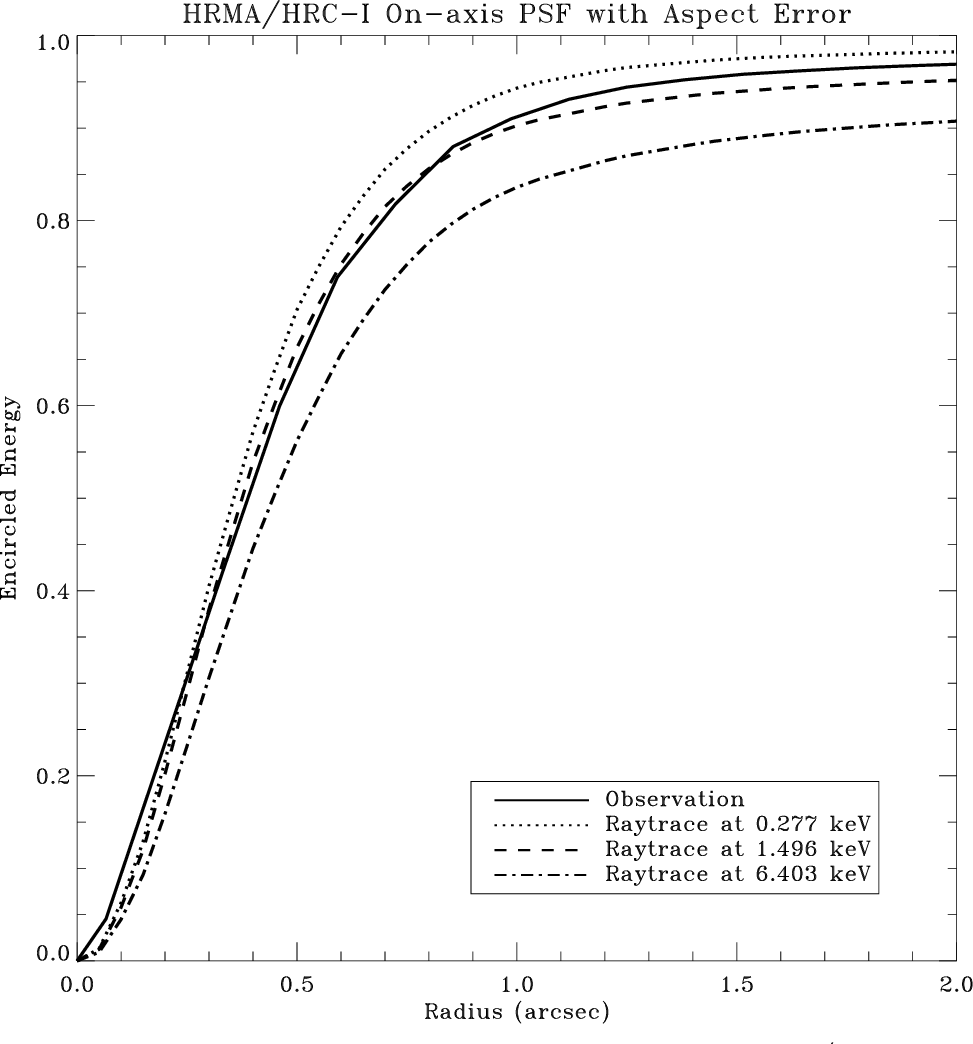
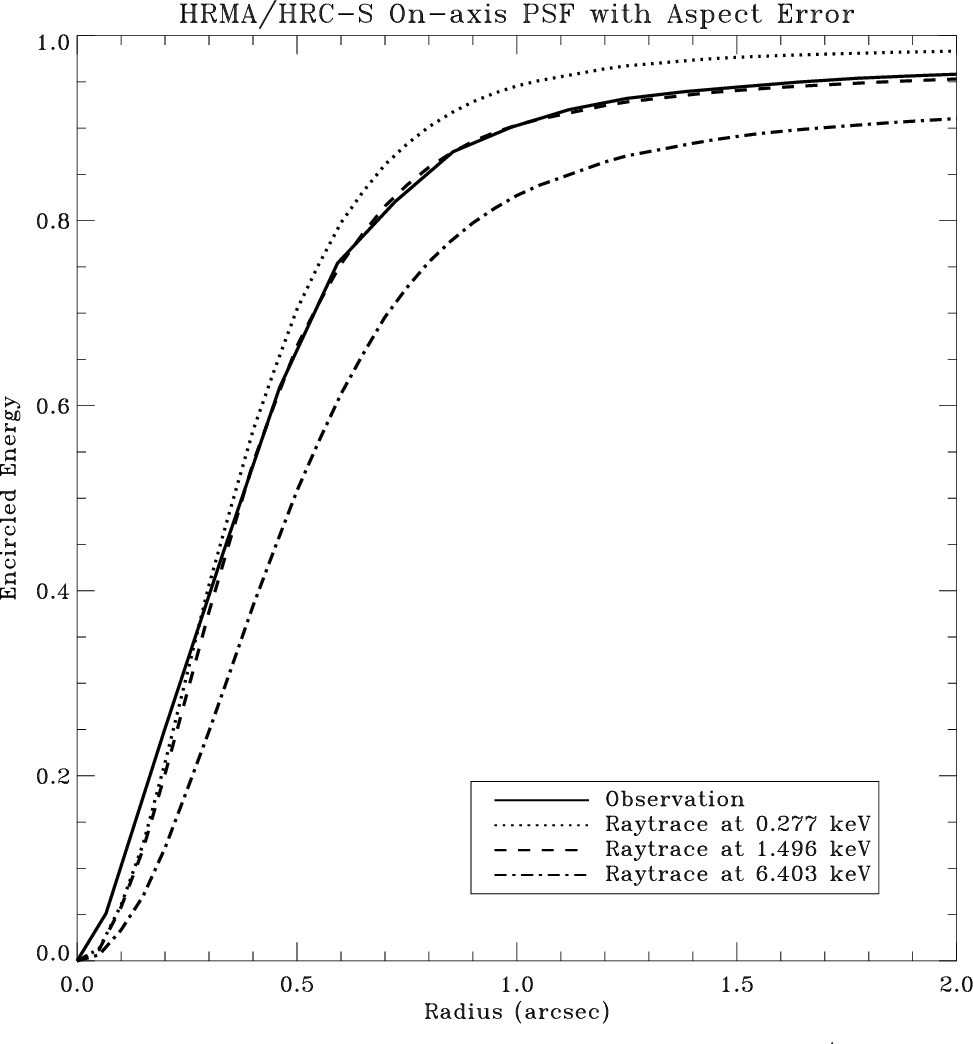
The HRMA performance discussed in the previous sections will be slightly degraded by uncertainties in the aspect solution and the details of the imaging detector spatial response function. The ground software system also deliberately adds a small random position error to reduce image artifacts which result from instrument and data system integer location values (the randomization may be turned off in data processing if desired). These effects are illustrated for the HRC-I and HRC-S instruments in Figures 4.18 and 4.19 respectively. These figures also show the fractional encircled energy as a function of radius actually observed in flight compared to model calculations at 0.277, 1.496 and 6.403 keV. An aspect error of 0.22′′ (FWHM) was included in the model calculations. The agreement between the observations and the lower energy model predicted curve is quite good.
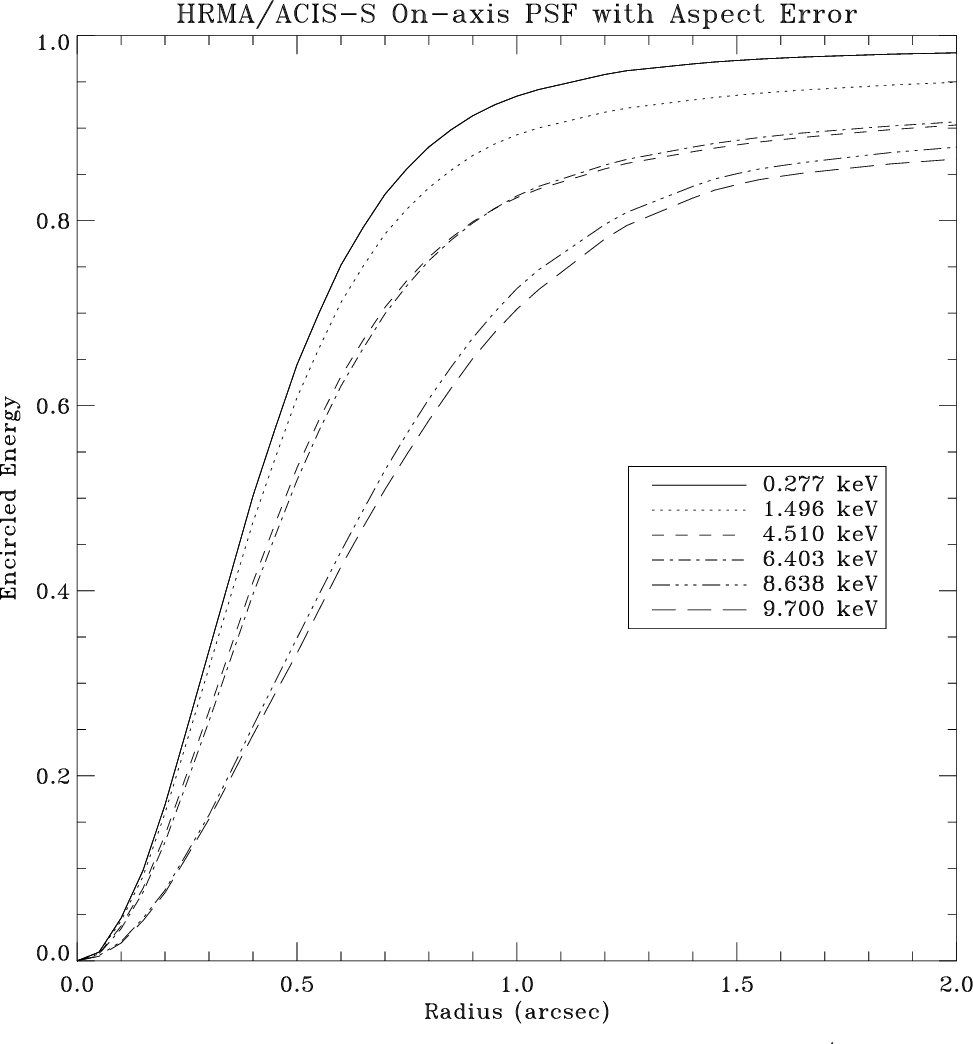
Similar calculations have been performed for the ACIS-S(S3) over a wider range of energies; the results are shown in Figure 4.20. The simulation accounted for the typical spacecraft jitter, so the location of the instrument pixel boundaries has little effect. There is, however, a small effect of the location of the source compared to the data system pixel boundaries. These particular calculations were performed for a point source centered on the boundary between two data system pixels. The ACIS-I instrument response is similar.
Figures 4.18, 4.19, and 4.20 may be compared with Figure 4.6 to estimate the image performance degradation due to non-HRMA effects.
./images/hrma_ee_aspect_hrc_i_point_obs_guide.png
Figure 4.18: The HRMA HRC-I on-axis fractional encircled energy as a function of angular radius from a point source (Ar Lac) observed in flight compared to raytrace simulations for an on-axis point-source at selected X-ray energies, including the aspect uncertainties and the HRC-I pixelization effects.
Link to pdf for Figure 4.18
./images/hrma_ee_aspect_hrc_s_point_obs_guide.png
Figure 4.19: The HRMA/HRC-S on-axis fractional encircled energy as a function of angular radius from a point source (LMC X-1) observed in flight compared to raytrace simulations for an on-axis point-source at selected X-ray energies, including the aspect uncertainties and the HRC-S pixelization effects.
Link to pdf for Figure 4.19
./images/hrma_ee_aspect_acis_s_01_point_guide.png
Figure 4.20: The fractional encircled energy as a function of angular radius expected for in flight ACIS-S(S3) measurements for an on-axis point-source at selected X-ray energies. The curves are the combined response of the four nested mirror pairs, typical aspect uncertainties, and the ACIS response function.
Link to pdf for Figure 4.20

4.5  References

Aschenbach, B. 1985, Rep. Prog. Phys. 48, 579
Aschenbach, B. 1991, Rev. Mod. Astron. 4, 173
Boese, F.G. 2000, Astron. Ap. Suppl. 507, 141
Edgar, R.J., et al. 1997, SPIE Proceedings, 3113, 124
Elsner, R.F., et al. 1998, SPIE Proceedings, 3444, 177
Gaetz, T.J., et al. 1997, SPIE Proceedings, 3113, 77
Gaetz, T.J., et al. 2000, SPIE Proceedings, 4012, 41
Gaetz, T.J., 2004, http://cxc.harvard.edu/cal/Hrma/psf/wing_analysis.ps
Gaetz, T.J. and Jerius, D. 2005, http://cxc.harvard.edu/cal/Hrma/users_guide
Gaetz, T.J., et al. 2004, SPIE Proceedings, 5165, 411
Giacconi, R., et al. 1979, ApJ, 230, 540
Graessle, D.E., et al. 1998, SPIE Proceedings, 3444, 140
Graessle, D.E., et al. 2004, SPIE Proceedings, 5165, 469
Henke, B.L., et al. 1993, Atomic Data and Nuclear Data Tables, 54, 181
Hughes, J.P., et al. 1993, SPIE Proceedings, 1742, 152
Jerius, D., et al. 2000, SPIE Proceedings, 4012, 17
Jerius, D., et al. 2004, SPIE Proceedings, 5165, 402
Jerius, D., et al. 2004, SPIE Proceedings, 5165, 433
Kolodziejczak, J.J., et al. 1997, SPIE Proceedings, 3113, 65
Marshall, H.L., 2005, http://space.mit.edu/ASC/calib/heg_meg/meg_heg_report.pdf
Marshall, H.L., 2005a, private communications
O'Dell, S.L. and Weisskopf, M.C. 1998, SPIE Proceedings, 3444, 2
Olds, C.R. and Reese, R.P. 1998, SPIE Proceedings, 3356, 910
Schwartz, D.A., et al. 2000, SPIE Proceedings, 4012, 28
Trümper, J., 1983, Adv. Space Res. 2(4), 241.
Van Speybroeck, L.P., et al. 1997, SPIE Proceedings, 3113, 89
Weisskopf, M.C. and O'Dell, S.L. 1997, SPIE Proceedings, 3113, 2
Weisskopf, M.C., et al. 2000, SPIE Proceedings, 4012, 2
Zhao, P., et al. 1993, SPIE Proceedings, 1742, 26
Zhao, P., et al. 1993, SPIE Proceedings, 1742, 75
Zhao, P., et al. 1994, SPIE Proceedings, 2011, 59
Zhao, P. and Van Speybroeck, L.P. 1995, SPIE Proceedings, 2515, 391
Zhao, P., et al. 1997, SPIE Proceedings, 3113, 106
Zhao, P., et al. 1998, SPIE Proceedings, 3444, 234
Zhao, P. and Van Speybroeck, L.P. 2003, SPIE Proceedings, 4851, 124
Zhao, P., et al. 2004, SPIE Proceedings, 5165, 482
Postscript copies of various aspects of the HRMA calibration can be obtained from the CXC Optics Calibration Group at http://cxc.harvard.edu/cal/Hrma/XRCF_Report/
A detailed guide to using and understanding the HRMA is available at http://cxc.harvard.edu/cal/Hrma/users_guide
Further information can be obtained from the MSFC Chandra calibration page at http://wwwastro.msfc.nasa.gov/xray/xraycal/

PREVIOUS INDEX NEXT
Last modified:01/24/08


The Chandra X-Ray Center (CXC) is operated for NASA by the Smithsonian Astrophysical Observatory.
60 Garden Street, Cambridge, MA 02138 USA.    Email: cxcweb@head.cfa.harvard.edu
Smithsonian Institution, Copyright © 1998-2004. All rights reserved.


File translated from TEX by TTH, version 3.79.
On 10 Jan 2008, 14:15.