(Last update 10/01/26)
The Chandra HRC-S detector suffered an anomaly in October of 2025 and is currently not available for LETG observations. HRC-S recovery efforts are continuing, and operations may be restored in fall 2026, but observers should consider using the LETG with HRC-I as an alternative.
While the LETG/HRC-I combination will suffice for many science objectives,
it is not a direct replacement for LETG/HRC-S. The main limitations are the
reduced LETG effective area at most wavelengths and lost coverage
beyond ~73 Å.
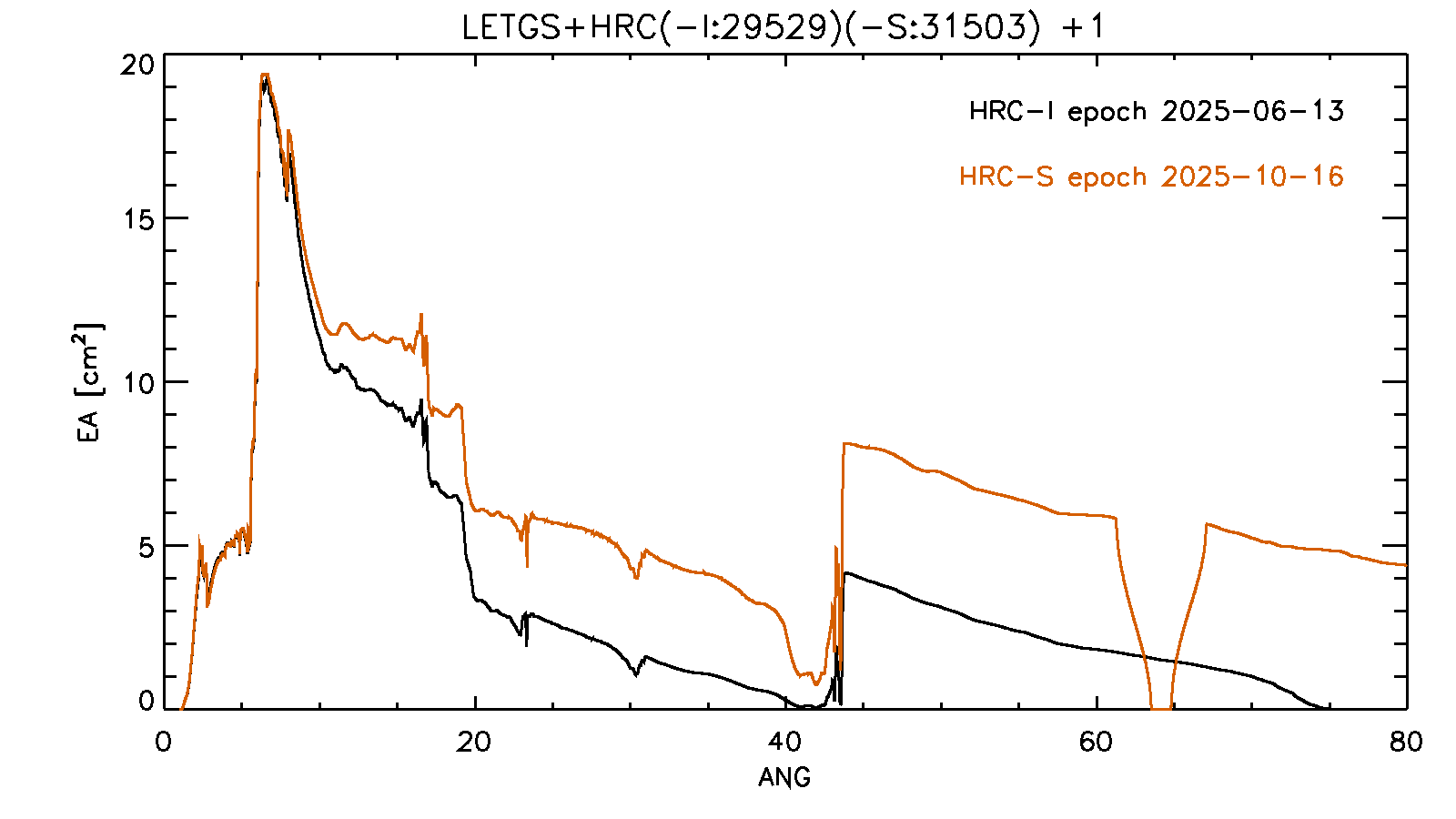
Below are Effective Area (EA) plots comparing HRC-S/LETG with HRC-I/LETG
for - and + orders from Oct and Jun 2025.
Based on trends at the HRC-I aimpoint, LETG/HRC-I EA is projected to
decrease by roughly 10% per year.
|
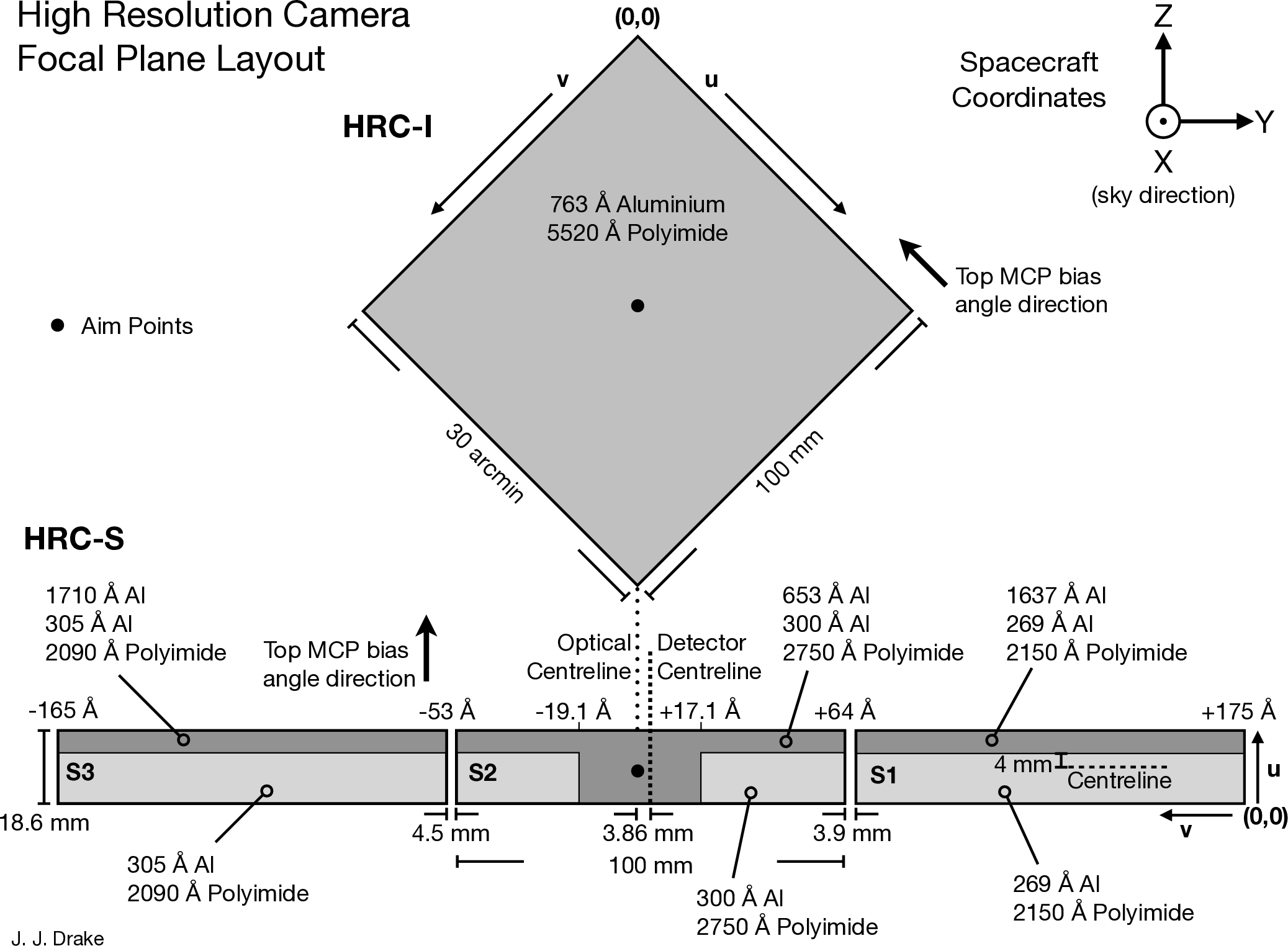
| Fig. 1: Layout of HRC-I and HRC-S detectors. |

|
| |
| Fig. 2a: Comparison of -1st order EAs for LETG/HRC-S and LETG/HRC-I. | Fig. 2b: EAs for +1st order with source at default aimpoint. |
The Effective Areas in Figure 2 are for:
1st and higher-order EAs with LETG/HRC-I currently have larger uncertainties than with LETG/HRC-S (although 0th order is well calibrated.) Our primary calibration source, HZ43, has very little flux short of ~60 Å, and harder sources such as Mkn 421 are variable, requiring more calibration data and detailed analysis to interpret accurately.
With those settings, the dispersed spectrum lies along the horizontal diagonal axis of the HRC-I (see Figure 1). EAs with HRC-I and HRC-S are fairly similar at wavelengths shorter than ~19 Å. At longer wavelengths, the LETG/HRC-I EA is usually somewhat less than half than that for LETG/HRC-S, with larger differences just short of the C-K edge around 45 Å, and beyond roughly 60 Å. The differences are caused by thicker polymide in the HRC-I's UV/Ion shield (5520 Å vs roughly half that for the HRC-S) and thicker Al (763 Å for the HRC-I vs ~300 Å for the HRC-S at wavelengths beyond ~19 Å).
Note that HRC-I quantum efficiency (QE) for the LETG 0th order is somewhat lower (very roughly 30% at all energies) at the default LETG aimpoint than elsewhere on the detector, which is irrelevant for most LETG observations. If maximizing the event rate in 0th order is necessary to achieve science objectives, a SIM Offset of +9.5 mm (used for most non-grating HRC-I observations) can be specified, but this reduces the LETG/HRC-I wavelength coverage by ~11 Å (to around ±62 Å) on each side because the dispersed spectrum is moved upward on the detector.
Using the default positioning listed above, and standard HRC dither of 40" full-width (corresponding to an interval of 2.24 Å), the wavelenth range unaffected by dither is approximately -72 to +73 Å. Wavelength coverage can be increased on one side (with corresponding loss on the other) by applying a Y Offset, extending the range by 3.36 Å per arcmin of offset. In principle, an offset of ~21' can be used and still position 0th order on the detector, extending + order coverage to ~144 Å, but effective area over the extended range will be very small, and resolution degrades rapidly at off-axis angles of more than ~5' (see POG Figure 7.7).
As noted in near the end of the Effective Area section, moving 0th order up or down relative to the detector center reduces wavelength coverage on both sides.
Because the HRC-I consists of a single plate, rather than the three plates of the HRC-S that approximately follow the LETG's Rowland circle (see POG Figure 9.5), spectral resolution will be slightly degraded at longer wavelengths. At the extreme ends, around 70 Å, X-rays from the largest of Chandra's four mirror shells will be diverging in a cone roughly 80 μm across as they intercept the detector surface, corresponding to a wavelength spread of a little less than 0.10 Å, about double the intrinsic LETG resolution (FWHM) of 0.05 Å. The broadening effect is, of course, smaller for the other three mirror shells (which account for ~60% of the total EA), and at shorter wavelengths, where LETG/HRC-I resolution is essentially the same as for LETG/HRC-S.
HRC-I background is half that of the HRC-S; see the POG figure for LETG/HRC-S background.

